
Knowledge
Lab Diamond Guide
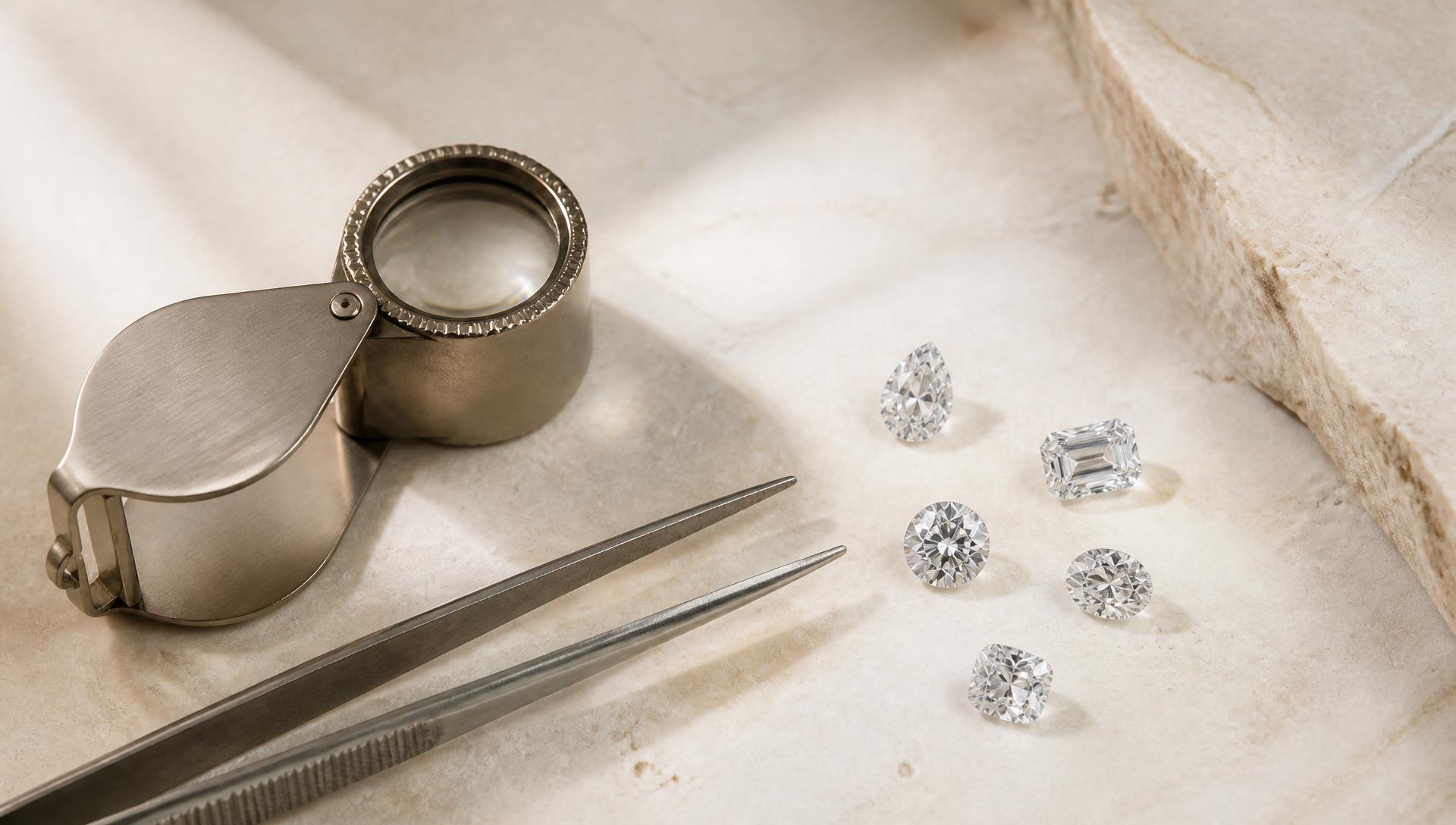
A lab-grown diamond shares the chemical composition, crystal structure and optical behaviour of a mined diamond. The only difference is its origin — and the certainty that comes with it.
This guide sets out how our stones are created, the cuts we work with, how to read a grading report and the certification that accompanies every Astrea London piece.
The science
How a lab diamond is grown
A diamond is a diamond, whether it is grown in a laboratory or taken from the ground.
Our stones begin as a slender diamond seed placed inside a chamber that recreates the conditions found deep within the earth. Carbon crystallises around the seed atom by atom, over several weeks, until a rough diamond emerges — chemically, optically and physically identical to a mined stone.
Because growth is controlled rather than accidental, our gemmologists can select stones of exceptional purity: the clarity, colour and precision we require are achieved far more consistently than nature allows.
Shape guide
The ten cuts
- Round brilliant
- Classic and timeless: fifty-seven facets engineered to return the greatest possible light.
- Oval
- The brilliance of a round cut in an elongated silhouette that flatters the hand.
- Radiant
- Trimmed corners and brilliant faceting: the elegance of an emerald with the fire of a round.
- Emerald
- Long step facets create a hall-of-mirrors effect and reward exceptional clarity.
- Pear
- A teardrop between round and marquise — singular, graceful, quietly theatrical.
- Cushion
- Softly rounded corners and vintage charm, with generous depth of sparkle.
- Princess
- Sharp corners and brilliant facets for a modern, architectural line.
- Asscher
- A square step cut with cropped corners and a deliberate, vintage geometry.
- Marquise
- Pointed ends maximise apparent size and lengthen the finger.
- Heart
- The most personal silhouette, demanding perfect symmetry from the cutter.
Quality
Reading the four C's
- Carat
- Weight, not size. Two stones of equal carat can read very differently depending on cut and proportion.
- Colour
- We work in the colourless range, D to F, so the stone reads as pure white light.
- Clarity
- Astrea selects VVS1 and VVS2 stones: inclusions are invisible to the eye and difficult to find under a loupe.
- Cut
- The one C decided by human hand — and the one that determines whether a diamond truly comes alive.
Value
Natural and lab-grown, side by side
D–E colour, VVS1 or better, round brilliant, excellent cut. Natural graded by GIA, lab-grown certified by IGI. Figures in US dollars.
A natural stone is bought at retail and sold at trade. The gap between those two numbers is the figure rarely printed on a price tag, so we set it out here against what the same specification costs, grown, today.
| Bought | Carat | Natural price paid then | Est. natural resale today | Est. loss | IGI lab-grown today |
|---|---|---|---|---|---|
| 2023 | 1 ct | $15k–$20k | $7k–$10k | 40–60% | ~$2,900 |
| 2023 | 2 ct | $50k–$70k | $25k–$40k | 35–55% | ~$8,600 |
| 2023 | 5 ct | $250k–$350k | $150k–$250k | 25–45% | ~$49,000 |
| 2021 | 1 ct | $16k–$22k | $7k–$10k | 40–60% | ~$2,900 |
| 2021 | 2 ct | $55k–$80k | $25k–$40k | 35–55% | ~$8,600 |
| 2021 | 5 ct | $275k–$400k | $175k–$275k | 20–40% | ~$49,000 |
| 2016 | 1 ct | $14k–$19k | $7k–$10k | 30–50% | ~$2,900 |
| 2016 | 2 ct | $45k–$65k | $28k–$42k | 20–40% | ~$8,600 |
| 2016 | 5 ct | $225k–$325k | $180k–$280k | 5–30% | ~$49,000 |
The lab-grown column shows the high end of current retail asking prices, not a resale value. Comparable stones are often listed for considerably less.
- Natural historical and resale figures are indicative ranges, not the appraisal of a particular stone. Retail replacement value and dealer resale value are different numbers.
- Large 5 ct D–E VVS1+ natural stones are highly individual: fluorescence, proportions, exact weight, polish, symmetry and liquidity can move value by tens of thousands of dollars.
- Sources: Rapaport Diamond Price List and its December 2021 and December 2023 historical sheets for natural benchmarks, PriceScope July 2026 for the current natural market, and Ritani category listings for IGI-certified lab-grown retail.
Certification
Independently verified
Every centre stone is graded by IGI and accompanied by its own report, which you may verify directly with the laboratory. Precious metals are hallmarked to UK standards and Astrea London is a registered Assay Assured Jewellery Retailer.
Our gemmologists are available to talk through a specific stone, cut or report before you commit.